Decision support that knows what has already been done.
Pogosh reads the chart — including the imaging and procedures your patient has already had — and returns the labs, imaging, specialist routing, and escalation criteria that actually change what happens next. Then it writes the note.
Not a search box you leave the chart to use. An API that is ready to deploy.
The gap is not knowledge. It is the next click.
Physicians usually know what is indicated. What costs time is turning that into the right orders, the right consult, and a written note — while the chart sits in another tab.
Reference tools make you leave the chart
You stop, search, read a monograph, then come back and translate prose into orders yourself. The translation step is where things get missed.
Most alerts do not know the patient
Advisories that fire on a diagnosis code cannot see that the CT was already done yesterday, or that the consult is already pending. So they repeat it — and clinicians learn to dismiss them.
The wrong study costs more than time
Selecting an imaging study that will not answer the question means another visit, another delay, and radiation the patient did not need.
What Pogosh returns
Structured, coded, and specific to the patient in front of you — not a document to read.
Orders that fit the chart
Labs with LOINC codes and imaging with RadLex codes, ranked by what changes management, each with the reason it is suggested. Studies already performed are accounted for instead of repeated.
Routing and escalation
Which specialty to involve, how urgently, and the specific findings that should escalate care. Interventional options appear where they are genuinely an option.
The note, written
A drafted clinical note grounded in the encounter — no invented findings, no fabricated negatives. Edit and sign. See it work →
Plus an emergency safety backstop
A separate check for time-critical presentations — dissection, cord compression, testicular torsion, cholangitis and others — so a true emergency is surfaced even when the primary match is something more common. Tuned to be specific: it stays quiet unless the defining findings are actually present.
One engine. Three places it shows up.
The same clinical engine powers the chart, the keyboard, and the classroom — which is the clearest evidence that it is a real API and not a single-purpose app.
In the chart
An OpenEMR module today, and a REST API for any EHR that can make an HTTPS request — including systems you built yourself.
At the keyboard
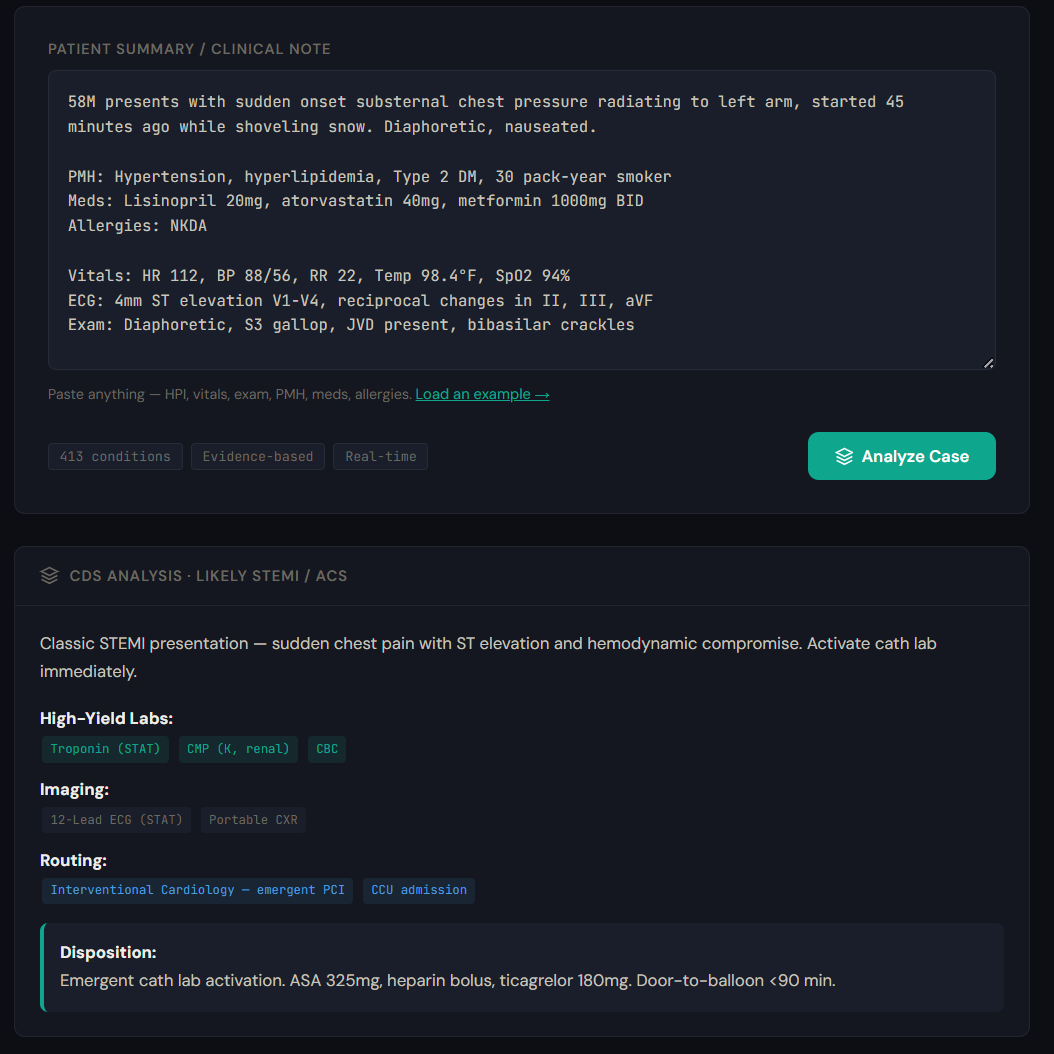
Paste a note, get the orders, routing, and a drafted note back. No account, no install — the fastest way to see whether the reasoning holds up.
In training
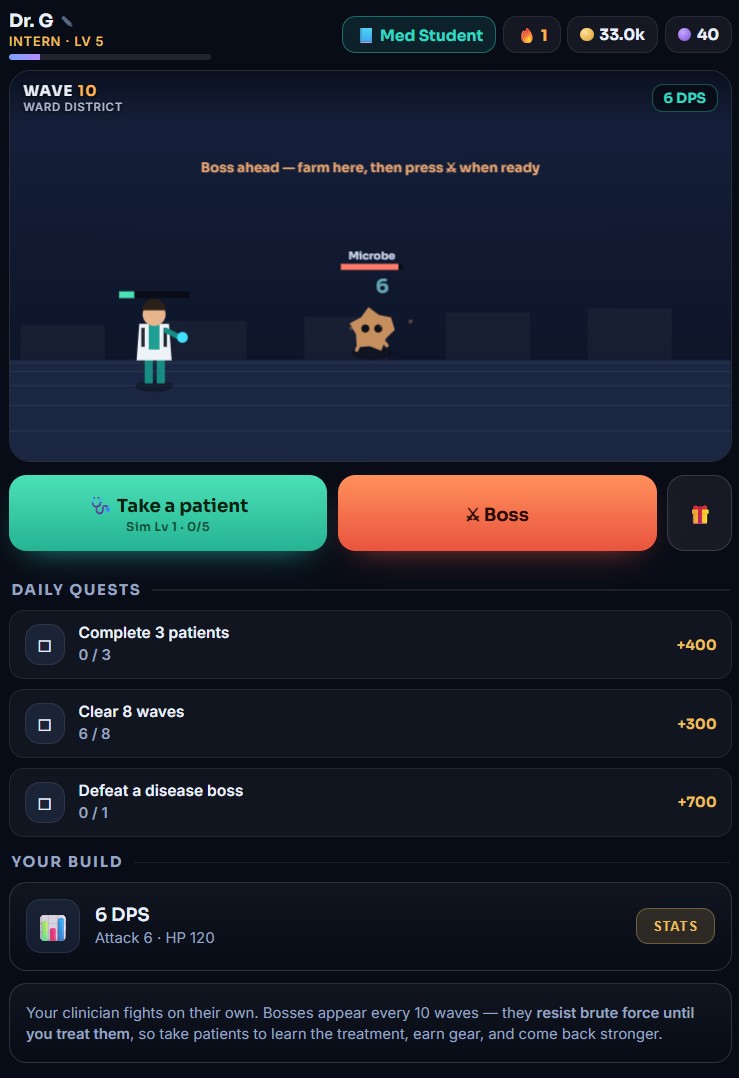
Clinical Crusader turns the same engine into a game for premeds, medical students, and residents — work a case, order the right tests, commit a diagnosis, level up.
Pogosh Rads drills radiology differentials by free recall: you type the diagnoses, and it scores two things separately — whether you led with what is likely, and whether you caught what is dangerous.
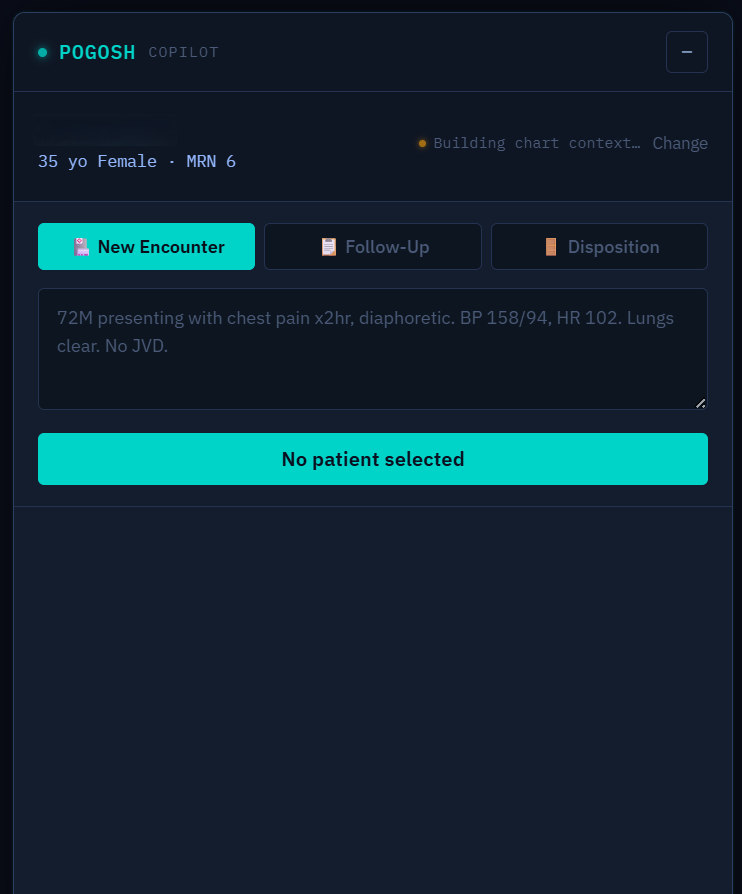
What chart-aware actually looks like
This is the Pogosh copilot running inside OpenEMR. Note the second line: it has read the chart — the notes, the conditions, the labs — before saying anything.
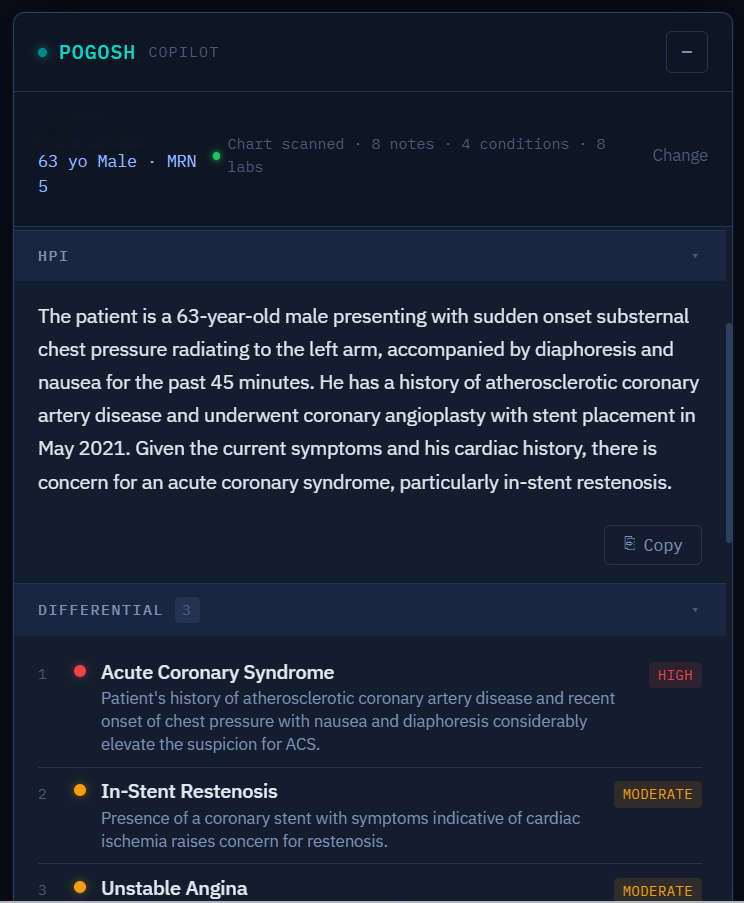
It reads the chart first
"Chart scanned · 8 notes · 4 conditions · 8 labs." The prior record is input, not an afterthought — which is what lets it skip what has already been done.
Prior procedures change the answer
The drafted HPI picks up a coronary stent placed in May 2021 from the chart history, and that history is why in-stent restenosis appears in the differential at all.
Ranked, with the reasoning shown
Each item carries its priority and the specific findings behind it, so you can disagree with it quickly. That is the point — you decide.
Built as an API. Ready to deploy.
Pogosh was built API-first, which means integrating it is an afternoon rather than a procurement cycle.
Any EHR
A documented REST endpoint. Send a note or a structured condition with patient parameters; get back JSON. Works alongside FHIR-based systems and custom-built EHRs.
BAA available
A HIPAA Business Associate Agreement is available for PHI. Evaluate and integrate on synthetic or de-identified data first, then enable PHI once the agreement is executed.
Coded output
LOINC for labs, RadLex for imaging, ICD-10 for conditions — so results map into your data model instead of needing to be parsed out of prose.
Pricing
Priced for independent practices and small teams, not for hospital procurement.
- Full condition coverage
- REST API access
- OpenEMR module
- Note generation
- Email support
- Everything in Clinic
- Higher rate limits
- Multiple providers
- Integration support
- Priority response
- HIPAA BAA
- Volume pricing
- EHR platform licensing
- Dedicated onboarding
- Clinical validation program
Building an EHR or a product that would embed Pogosh for other practices? That is a platform licence — mention it below and we will scope it with you.
Get access
Tell us a little about where you would use it. We read every one of these — you will hear back from a physician, not a sales sequence.
Questions
What is Pogosh CDS?
Pogosh CDS is a clinical decision support system for physicians and EHR developers. Given a clinical note or a structured condition, it returns the specific labs, imaging studies, specialist routing, and escalation criteria relevant to that patient, plus a drafted clinical note. It is delivered as a REST API, an OpenEMR module, and a browser tool.
What does "chart-aware" mean?
Pogosh accounts for what has already been done. If the patient already had a CT abdomen and pelvis two days ago, Pogosh does not recommend ordering it again — it moves to what actually changes management next. Decision support that only reads a diagnosis code cannot do this.
How is this different from a clinical reference tool?
Reference tools answer a question you go and ask. Pogosh returns structured, coded, machine-readable orders your chart can act on — labs with LOINC codes and imaging with RadLex codes — so recommendations can be surfaced inside the workflow instead of in a separate tab.
Does it work with my EHR?
Yes. Pogosh is a REST API, so it can integrate with any EHR that can make an HTTPS request. There is a ready-made OpenEMR module, and the API is designed to work alongside FHIR-based systems. Independent and custom-built EHRs are explicitly supported.
Is a HIPAA Business Associate Agreement available?
Yes. A BAA is available for customers transmitting protected health information. PHI-handling deployments run on HIPAA-eligible infrastructure. Evaluation and integration work can be done with synthetic or de-identified data before any BAA is executed.
Does Pogosh replace clinical judgment?
No. Pogosh is decision support: it surfaces what the guidelines and the chart suggest, and the treating clinician decides. Every recommendation is reviewable, and the reasoning behind each suggested order is shown alongside it.
Can I try it before buying?
Yes. You can paste a clinical note at pogosh.com/try and see the labs, imaging, routing, and a drafted note immediately, with no account. A free evaluation API key is available for developers integrating Pogosh into an EHR.
Who builds Pogosh?
Pogosh CDS is built by GigHz LLC and was created by a practicing interventional radiologist. It is designed around what actually goes wrong in ordering, imaging selection, and specialist routing in real clinical practice.
See whether the reasoning holds up.
Paste a real note. Judge it yourself — you are the one who decides.